
The high-speed brake slam.
You plug your dead phone into a massive, heavy brick of a fast charger, watch the percentage numbers literally tick upward while you brush your teeth, and feel an incredible sense of technological satisfaction as your battery screams from zero to fifty percent in less than fifteen minutes flat. It feels like magic.
Then the internal brakes slam on.
You glance down an hour later only to find the progress indicator agonizingly stuck at eighty-seven percent, realizing that the lightning-fast juice injection completely evaporated and turned your hyper-engineered charging kit into a slow, sluggish power trickle that behaves exactly like an ancient gas station cord from a decade ago.
Personal Sidenote: I spent an evening tracking live wattage delivery curves using a digital USB-C inline power meter. My phone pulled a screaming 45 watts from the wall without breaking a sweat until the exact millisecond the internal fuel gauge crossed the 80% line, where the charge controller instantly choked the input current down to a pathetic 5 watts. The hardware is actively fighting against the charger.
The part nobody talks about.
Smartphone brands are terrified of an expensive, brand-destroying explosion.
When a lithium-ion battery is empty, its internal chemical structure is wide open and completely starved for electrons, meaning it can absorb an absolute torrent of electrical current safely without building up destructive atomic pressure inside the sealed foil casing.
Look, honestly, between you and me, the phone companies don’t care about your time.
They care about safety metrics.
If they allowed that raw, firehose blast of electrical current to continue hammering the internal cell configuration all the way to one hundred percent, the internal chemical layer would violently overheat, expand like a balloon, and eventually cause the battery structure to melt right through your glass screen panel. They built a strict electronic ceiling directly into the operating system kernel to protect themselves from massive class-action product liability lawsuits.
Quick Reality Check
- The Myth: Leaving your phone plugged in after it hits 80% damages the battery because the charger continues to force high-voltage power into the cell.
- The Fact: The charging block is completely passive; your phone’s internal power management chip dictates the draw, meaning the device throttles itself down to protect its own chemistry.
Wait, it gets weirder.
Think of your battery like a massive, empty stadium parking lot.
Honestly, I know what you’re thinking. You assume that filling up the final twenty percent of a battery should take a fraction of the time because there are fewer empty slots left to cram electrons into before the phone is ready to go. You have the physics completely backward.
When the lot is totally empty, arriving cars can speed through the gates and park anywhere.
But as the parking spaces hit eighty percent capacity, incoming drivers have to slow down to a literal crawl, carefully searching through every single row to find the few remaining open slots without crashing into the vehicles already parked there.
shift from the firehose to the eyedropper.
Physics doesn’t bend for your schedule. Cold, immutable chemistry dictates the timeline. If you want to understand why your charging speeds fall off a cliff, you must understand the two distinct phases that govern the lifecycle of every modern lithium-ion power cell.
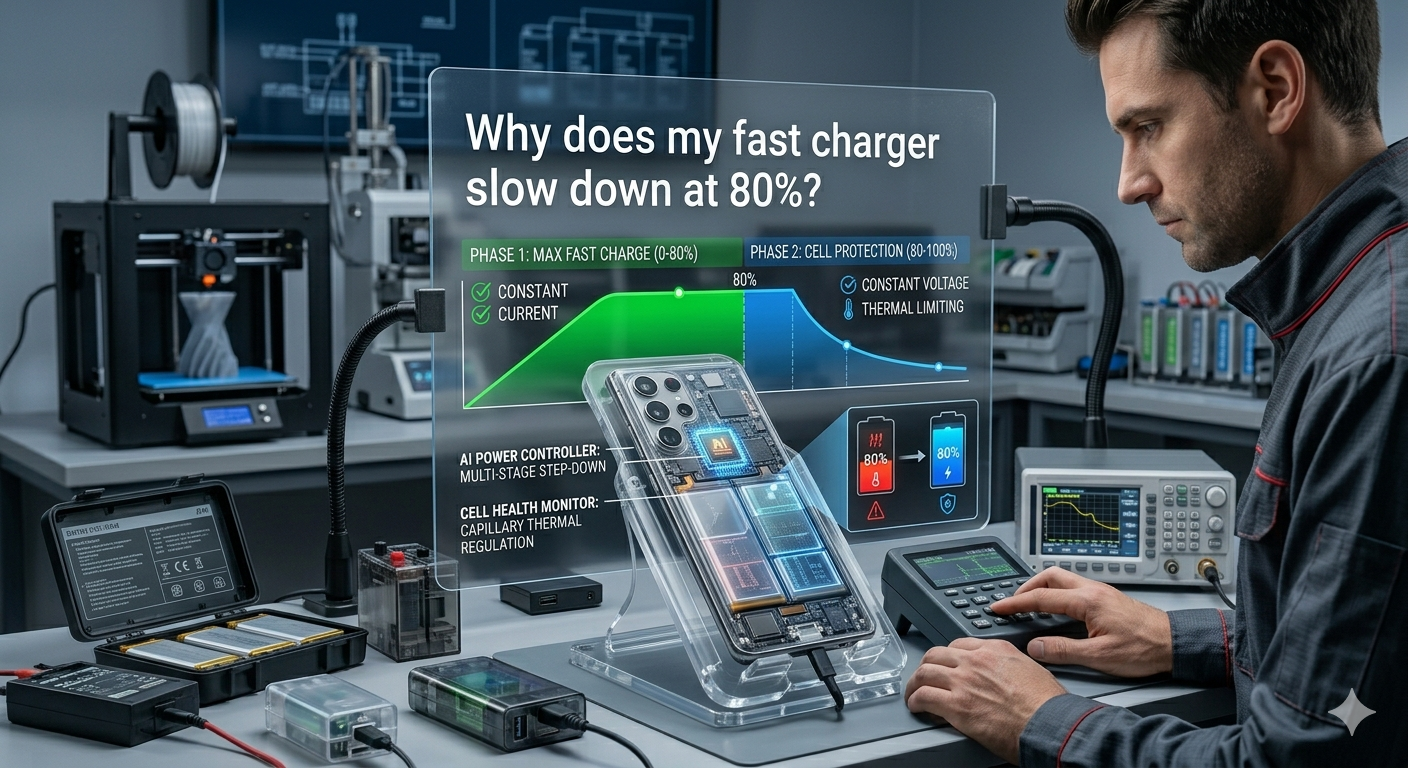
First, look at the transition from Constant Current (CC) to Constant Voltage (CV).
[0% to 80% Capacity] ➔ Phase 1: Constant Current (Maximum Wattage Firehose)
[80% to 100% Capacity] ➔ Phase 2: Constant Voltage (Slow, Regulated Eyedropper)
During the initial phase, the phone’s charge controller keeps the electrical current high and raises the voltage progressively to jam energy into the empty cell structure as quickly as possible.
Once the cell hits its safe voltage saturation limit at 80%, the system drops Phase 1 entirely.
The 80% thermal throttling breakdown.
| Charging Phase | Device Percentage | Input Wattage Behavior | Internal Battery Stress Level |
| Constant Current (CC) | 0% to 80% | High-output burst (e.g., 45W–100W) | Low resistance, minimal heat buildup |
| Constant Voltage (CV) | 80% to 100% | Gradual tapering drop (e.g., 15W down to 2W) | Maximum internal pressure, high thermal risk |
As the voltage peaks, the internal resistance inside the chemical layers spikes dramatically, meaning any extra current pushed into the phone would merely convert into raw, destructive heat rather than stored energy.
Personal Sidenote: Modern smartphone software suites like Apple’s iOS and Android 16 feature “Optimized Battery Charging” or “Adaptive Charging” protocols. These subroutines learn your daily alarm schedules and purposefully lock the device at 80% overnight, only allowing the slow, high-stress final 20% trickle to finish right before you wake up to protect the lifespan of the chemical bonds.
The physical degradation bottleneck.
Do not assume your fast charging block is defective or losing its strength when the progress bar stalls out. The slowdown is the sign of a healthy, functioning Power Delivery (PD) protocol communication loop.
Look, honestly, I know what you’re thinking. You want to buy a massive 120-watt brick to try and force the phone to bypass this bottleneck. It won’t work.
The phone’s internal charge controller will flat-out reject the extra wattage to prevent thermal runaway.
If you constantly force your phone to sit at 100% capacity while exposed to high ambient temperatures, you are actively accelerating the degradation of the lithium ions, cutting your overall battery lifespan completely in half.
Quick Reality Check
- The Myth: Fast charging your phone from 0% to 80% every single day will ruin the battery health within a few months.
- The Fact: The first 80% of fast charging causes very little structural stress; the real wear and tear happens exclusively during the slow, high-voltage push from 80% to 100%.
Optimize your charging routine and stop wasting time at the wall.
Staring at your phone screen waiting for that final 20% to top off is a massive waste of productivity. The amount of time it takes to go from 80% to 100% is often identical to the time it took to blast from zero all the way to eighty.
Stop obsessing over a full 100% charge icon. Unplug your device the exact moment it hits the 80% chemical wall, rely on the high efficiency of modern mobile chipsets to get you through your afternoon workflows, and only top off completely when you know you will be away from a power outlet for an extended weekend journey.