
The multi-million-dollar corporate landfill dump.
We have all been conditioned to think that if we want to run a bulletproof home server—something that securely hoards our personal media files, runs automated backups, manages our smart-home devices, and hosts private websites—we need to drop a massive paycheck on a huge, custom-built tower packed with whirring fans and glowing lights. It is a total marketing trap.
You are being played by the hardware brands.
Right now in 2026, massive multinational corporations are purging millions of perfectly working, enterprise-grade mini computers from their office inventories because their three-year corporate leasing contracts expired, creating a massive logjam in the secondary electronics market where liquidators are practically giving away elite hardware for pennies on the dollar.
Personal Sidenote: I was scrolling through an industrial liquidation auction site this morning. A bank in Ohio just dumped seven hundred Lenovo ThinkCentre Tiny units with Intel 8th-generation processors onto the market for eighty dollars a pop. Eeighty bucks. If you tried to buy those individual server-grade chips at retail, you’d pay double that price just for the silicon inside the chassis.
The part nobody talks about.
The Raspberry Pi hype train ruined budget homelabs.
For the last few years, every single tech influencer online has screamed at regular consumers to build their home infrastructure around tiny single-board hobby computers, completely ignoring the fact that by the time you buy a plastic case, a reliable power supply, a fast micro-SD card, and an external hard drive enclosure, you have spent close to two hundred dollars on a weak, underpowered setup that buckles under a heavy data load.
Look, honestly, between you and me, those hobby boards are a toy.
They break constantly.
If you attempt to stream a high-bitrate movie to your living room television while your automated backup scripts are running in the background, the underpowered processor spikes to one hundred percent utilization instantly, causing your entire network to grind to a halt because the hardware simply lacks the processing power to handle simultaneous multi-threaded workflows. If you want a real machine, you have to look at the machines built for corporate 24/7 infrastructure.
Quick Reality Check
- The Myth: Refurbished office micro PCs consume too much electricity and will cause your monthly household utility bill to skyrocket.
- The Fact: These small-form-factor units utilize ultra-efficient laptop-class processors that idle at less than 10 watts of power, making them just as efficient as hobby boards while offering five times the processing speed.
Wait, it gets weirder.
The real goldmine is hidden inside the Intel Quick Sync engine.
Honestly, I know what you’re thinking. You assume that because these corporate units lack a giant, power-hungry graphics card sticking out of the side, they will fail miserably the moment you try to decode high-definition video files across your home network. You are completely wrong.
Intel’s office chips contain a dedicated, hardwired video processing block that bypasses the main processor entirely.
The raw math of corporate surplus.
Look, you don’t need a massive chassis or enterprise server racks to run an absolute powerhouse of a home server. You just need to let the global banking systems and medical conglomerates take the initial 80% depreciation hit for you.
When a multi-billion-dollar corporation cycles out their desk hardware, they don’t carefully evaluate individual chip performance. They execute bulk liquidations.
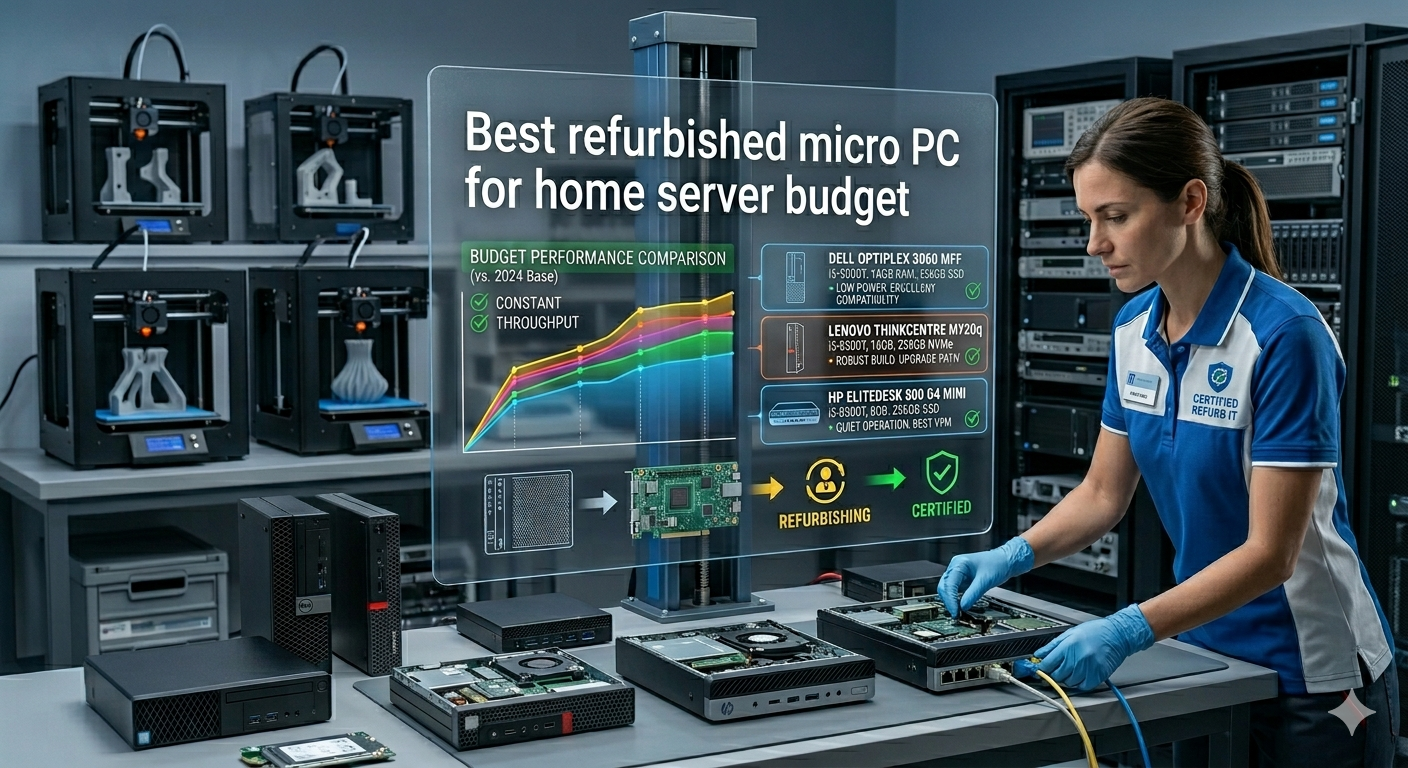
This means that three core form-factors rule the budget secondary market: the Lenovo ThinkCentre Tiny, the Dell OptiPlex Micro, and the HP ProDesk/EliteDesk Mini series.
They are essentially the exact same layout.
+-------------------------------------------------------+
|  [Rear I/O: Gigabit LAN, USB 3.2, DisplayPorts]       |
+-------------------------------------------------------+
|  [Internal: 2.5" SATA SSD Bay / HDD Slot]            |
|                                                       |
|  [Dual DDR4/DDR5 SO-DIMM Slots]                       |
|                                                       |
|  [M.2 NVMe PCIe Storage Slot]                         |
+-------------------------------------------------------+
|  [Front I/O: Power, USB-C, Audio Jacks]               |
+-------------------------------------------------------+
They take up zero space, run completely silent on a closet shelf, and draw less than 10 watts of power when sitting idle.
The target specification matrix.
Do not click buy on the first cheap listing you spot on eBay or Amazon Renewed. If you buy an architecture that is too old, you will accidentally cross-reference yourself into a hardware corner where modern operating systems drop support.
Look, honestly, I know what you’re thinking. You want to buy a super cheap Intel 4th-generation machine for $45 because the price looks like an absolute steal. It is a trap. Those older silicon architectures lack modern hardware transcoding engines and devour three times the power at idle.
The 2026 budget tier breakdown.
| Recommended Model Series | Core CPU Generation | Target Price Window | Primary Homelab Use-Case |
| HP ProDesk 400/600 G4 Mini | Intel 8th-Gen (i5-8500T) | $75 – $95 | Plex Media Server / Docker Containers |
| Lenovo ThinkCentre M720q Tiny | Intel 9th-Gen (i5-9500T) | $95 – $120 | Proxmox Virtualization Node / Home Assistant |
| Dell OptiPlex 3080/5080 Micro | Intel 10th-Gen (i5-10500T) | $120 – $145 | Heavy Multi-VM Lab / TrueNAS Core Node |
If you stick strictly within this 8th-to-10th-generation Intel sweet spot, you gain native support for Windows 11 Pro licenses, absolute compatibility with the Proxmox VE hypervisor, and full access to Intel Quick Sync video processing.
Personal Sidenote: Make sure you explicitly look for the “T” suffix on the Intel processor models (like i5-8500T). The “T” signifies a low-power, thermally optimized 35-watt desktop chip that handles continuous 24/7 server workloads without baking the tiny internal motherboard or causing your cooling fans to scream at full volume all night.
Quick Reality Check
- The Myth: You need an enterprise-grade hardware RAID controller card to ensure your home server data remains safe from drive failures.
- The Fact: Modern open-source operating systems like TrueNAS SCALE and Linux use software-defined filesystems (ZFS) that handle disk redundancy completely via software, rendering old physical hardware RAID cards entirely obsolete.
Secure your hardware node before the liquidation surplus thins out.
Every single week, thousands of home tech enthusiasts discover this exact hardware loophole, quickly sweeping up the best high-tier corporate liquidations from the market and driving up the costs of the remaining secondary inventory.
Stop letting the major retail consumer brands convince you to buy over-priced, under-powered plastic mini PCs or fragile hobby boards. Get on eBay or your preferred secondary marketplace right now, search for a certified refurbished Intel 8th-gen or newer micro chassis from Lenovo, Dell, or HP, lock in your node infrastructure for under a hundred bucks, and launch your own private home cloud platform tonight.