
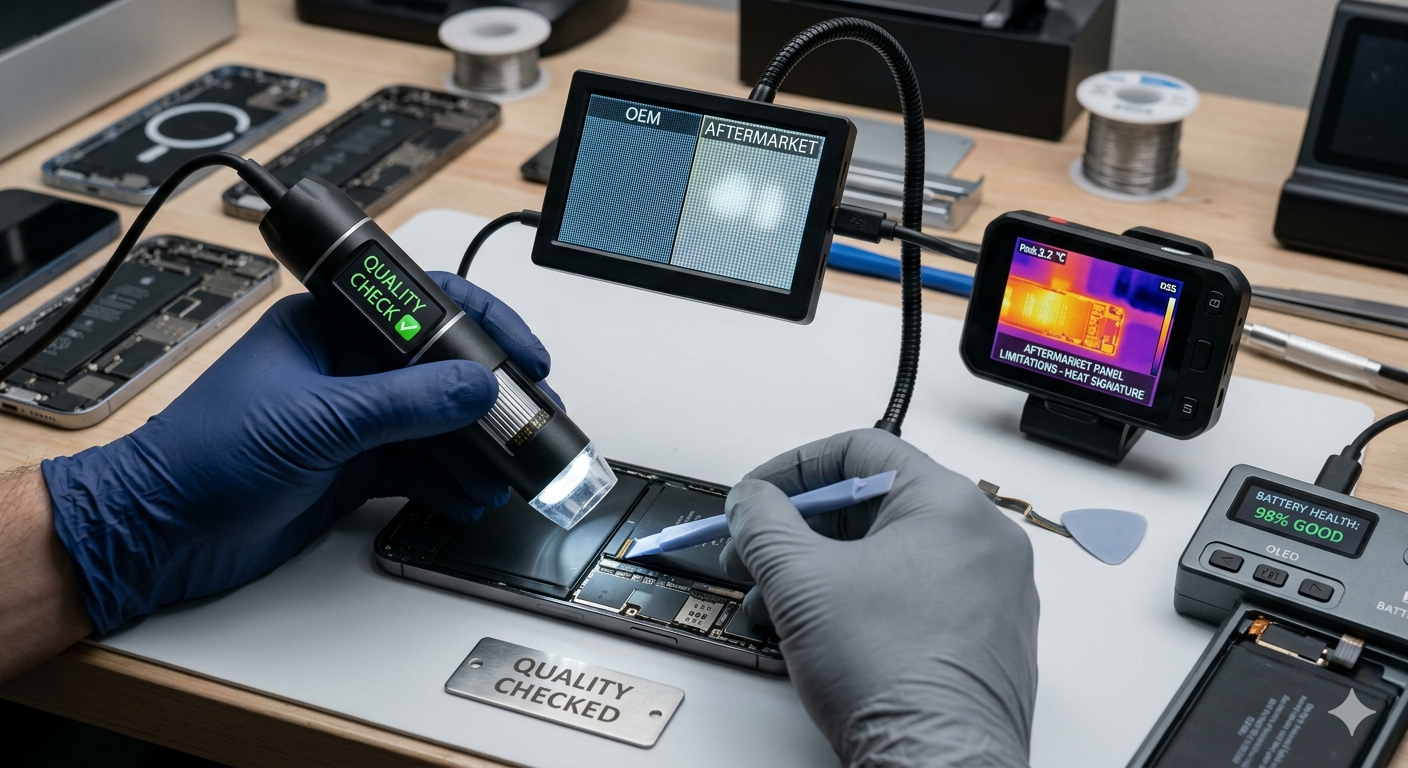
The pristine glass illusion.
You unbox the device, peel back the satisfying protective plastic layer, admire the lack of scuffs on the aluminum chassis, and happily assume you just beat the retail system by saving $300 on a refurbished flagship. It feels like a massive victory.
Then you turn it on.
The colors look just a tiny bit washed out, the touch registry feels marginally sluggish when you are flying across your keyboard, and that deep, ink-like black level you expected from a premium Apple OLED panel looks suspiciously like a cheap, low-contrast kitchen television screen.
Personal Sidenote: I spent an afternoon with a micro-soldering tech at a repair depot last month who showed me bins containing thousands of harvested original screens. Disreputable online refurbishers routinely strip the genuine, high-dollar Apple displays off broken trade-ins to sell them individually for parts, swapping in a glitchy, $15 third-party knockoff panel before shipping the patched-up phone to you.
The part nobody talks about.
Silicon Valley doesn’t want you swapping parts without paying the corporate tax.
Apple explicitly serializes every single display panel to its specific logic board at the factory level, creating a hardcoded digital handshake that immediately breaks the moment an unauthorized third-party technician uncrews the shield plates and drops a non-genuine screen into the housing.
Look, honestly, between you and me, the tech giants hate the refurbished market. They would much rather you give up on the secondary market entirely, hand over your credit card for a brand-new retail unit, and stay locked in their closed ecosystem. But because they lost major Right to Repair battles recently, they had to build internal whistleblowing tools right into iOS that flash bright red warning lights the exact microsecond a counterfeit component attempts to run on their hardware.
Quick Reality Check
- The Myth: If an iPhone has True Tone enabled and working, the screen is guaranteed to be 100% genuine Apple hardware.
- The Fact: Cheap reprogramming tools like the QianLi iCopy allow shady repair shops to copy the display data from a broken original screen and flash it onto a cheap aftermarket panel to trick the True Tone sensor.
Wait, it gets weirder.
The ghost touches start after the first software update.
Honestly, I know what you’re thinking. You assume that if a screen looks sharp and registers your thumb swipes during the first five minutes of opening the box, you are completely out of the woods. You aren’t.
The aftermarket manufacturers are constantly playing a game of cat-and-mouse with Apple’s firmware engineers.
The moment a major new iOS revision drops over the air, the proprietary code routinely patches the bootloader exploits that the knockoff screens use to mimic genuine hardware, leaving you holding a glitchy, bricked brick of glass that ignores half your typing commands because the controller chip inside the bezel can no longer translate the updated syntax.
Strip away the cosmetic facade and audit the system logs.
Staring at a glossy screen and guessing won’t expose a cheap knockoff panel. Methodical, digital interrogation will. If you want to uncover the truth about a refurbished iPhone’s hardware origin, you must ignore the seller’s marketing claims and check the internal operating system logs directly.
First, unlock the phone and navigate straight into the core firmware diagnostics tree. Apple built a hardcoded snitch right into the software code specifically to track grey-market parts.
You need to force the hardware registry to show its hand.
The iOS hardware verification index.
| System Menu Path | Expected Output Status | Component Integrity | Hardware Reality |
| Settings > General > About | No History Section Present | 100% Factory Sealed | Original screen remains intact |
| Settings > General > About | “Genuine Apple Part” | Verified Service Profile | Screen replaced by Apple with OEM glass |
| Settings > General > About | “Used Part” (iOS 18+) | Component Swapped | Original Apple screen pulled from a donor phone |
| Settings > General > About | “Unknown Part” | Validation Handshake Failed | Third-party aftermarket panel detected |
If your device is running modern software and you spot that bolded “Unknown Part” flag underneath a newly populated Parts and Service History tab, the debate is officially over. Your device has a counterfeit screen.
Personal Sidenote: Shady liquidators love selling refurbished phones with older operating systems installed. They purposefully leave the phone on ancient firmware because old versions of iOS do not have the advanced cryptographic checks needed to detect third-party display controller chips. The very first thing you should do when evaluating a device is force an over-the-air update to the absolute newest firmware version to trigger the automated security audits.
The physical override tests.
Do not try to use basic touch tests or download generic screen testing apps from the App Store. Those apps just read standard pixels; they cannot see the physical construction of the display panel or calculate behavioral light physics.
Instead, execute a raw visual frequency test using an external polarized light filter.
Look, honestly, I know what you’re thinking. You are worried that you need a specialized engineering laboratory to perform a physical component check. You don’t. Simply put on a standard pair of polarized sunglasses, hold the iPhone at a sharp 45-degree angle, and rotate the chassis slowly under direct lighting. Genuine Apple OLED screens handle light waves evenly across the matrix, whereas cheap third-party LCD replacements will instantly distort, flash rainbow bands, or turn completely pitch black because their budget polarizing layers are misaligned.
Quick Reality Check
- The Myth: If the screen resolution looks sharp and the text isn’t pixelated, the display is definitely an original Apple component.
- The Fact: High-tier aftermarket copycats duplicate the original pixel density perfectly, but they use cheap glass that shatters under minor pressure and lacks the fingerprint-resistant oleophobic coating of real OEM panels.
Expose the fake hardware before your return policy runs out.
Third-party display panels dramatically lower the resale value of your device, drain your internal battery at twice the normal rate, and are highly prone to sudden touch failure during future software updates.
Stop letting independent resellers pad their profit margins by selling you patched-up, non-genuine hardware. Pick up the device right now, tap through to the internal service history sub-menus, run the polarization check, and demand a full refund or a genuine replacement the exact moment you find a hidden third-party chip in your device pipeline.
This walk-through demonstrates exactly how the internal iPhone display microchips communicate with the iOS operating system and shows the technical methods used to handle the “Unknown Part” system warnings during a screen replacement.